By Emma Akpabio
In many Nigerian homes, a serious medical diagnosis often triggers a second crisis. Families begin to ask a difficult question: Should we travel abroad for treatment?
For decades, thousands of Nigerians have looked beyond the country’s borders for highly specialized care. travelling to Europe, India, the Middle East, or South Africa for procedures that local hospitals could not easily provide.
That long-standing pattern of foreign medical trips is what the government of Akwa Ibom State hopes to gradually reverse through the Ibom International Hospital, a major health facility currently under development.
Conceived as a world-class quaternary-level referral centre designed to meet international standards upon completion, the hospital represents a central pillar in the healthcare vision of Governor Umo Eno, who has consistently emphasized the need to strengthen Nigeria’s capacity for advanced medical treatment at home.
Still under construction, the Ibom International Hospital is expected to serve as a hub for highly specialized care that could reduce the need for costly overseas medical trips by providing complex treatments within the country.
The project forms part of a broader strategy to position Akwa Ibom State as a centre for advanced healthcare delivery, medical research, and professional training.
Rising along the state’s developing medical corridor, the hospital sits within the planned Ibom Medical City, an integrated health ecosystem envisioned to include research institutes, pharmaceutical manufacturing parks, academic institutions for health sciences, a senior citizens centre, and a modern residential medical village for healthcare professionals.



Even in its current stage of development, the scale of the hospital reflects an ambition rarely seen in Nigeria’s healthcare landscape.
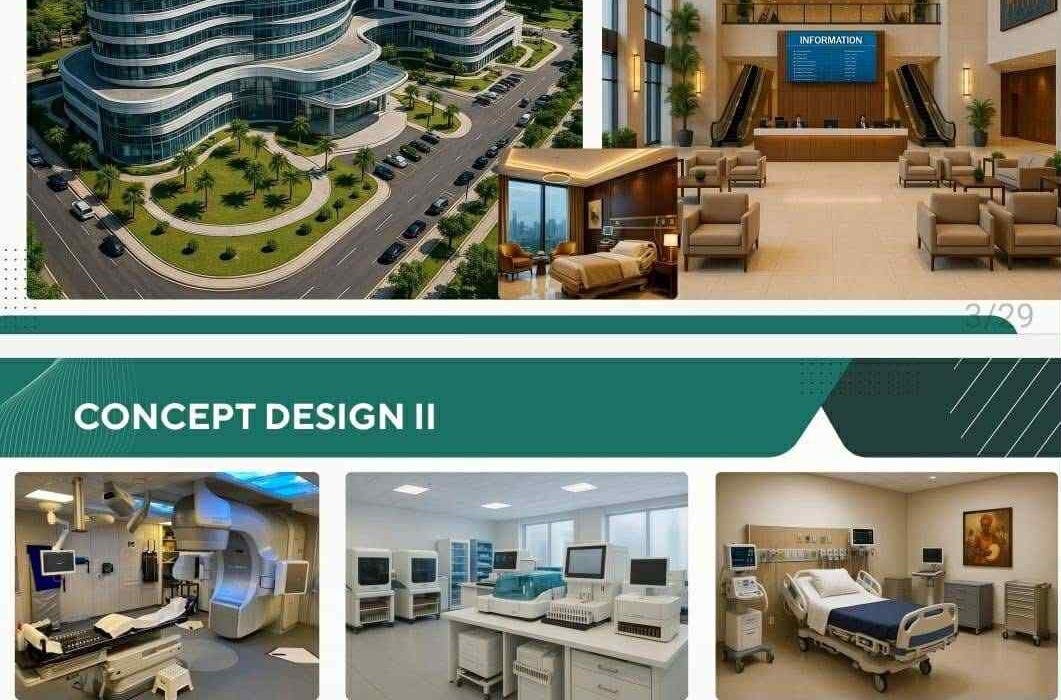
When completed, the facility will stand on about 37,000 square metres of space, rising eight floors above a basement level. A grand three-storey reception atrium will serve as the main entry point, designed to create an architectural experience similar to that of leading international medical centres.
The hospital is being developed as a quaternary-level referral centre, an elite class of medical facilities designed to handle the most complex health conditions. While most hospitals in Nigeria operate at primary, secondary, or tertiary levels of care, quaternary centres are equipped to provide ultra-specialized treatments such as transplant medicine, advanced neurosurgery, complex cardiac procedures, and precision cancer therapy.
Beyond its clinical focus, the hospital’s design also reflects a growing global emphasis on holistic healing environments.
Plans include three wellness gardens located within the complex, including a rooftop garden dedicated to lifestyle medicine and patient recovery. These spaces are intended to create calming environments that support healing beyond traditional clinical care.
Infrastructure planning has also taken into account the demanding needs of modern healthcare delivery.
A two-megawatt solar farm is being integrated into the hospital’s energy architecture to help ensure uninterrupted power supply for critical medical equipment. The facility will also feature a helipad for emergency air evacuation and rapid transfer of critically ill patients, alongside parking space for about 150 vehicles and additional underground parking designed for VVIP access.
However, what may ultimately distinguish the Ibom International Hospital most strongly from many other hospitals across the country is the level of advanced medical technology planned for its operations.
When fully operational, the hospital is expected to house cutting-edge diagnostic and treatment systems such as a PET-CT scanner, a 3-Tesla MRI machine, and a cyclotron used in the production of radiopharmaceuticals for precision diagnostics.
Cancer treatment is also expected to benefit from the TrueBeam radiotherapy system, a highly advanced linear accelerator designed to deliver targeted radiation therapy with greater precision.
Surgical services are planned to operate at an equally sophisticated level.
The facility is designed to include ten modular operating theatre suites equipped for highly specialized procedures, including super-sterile environments dedicated to neurosurgery, transplant surgery, ophthalmology, ear-nose-throat surgery, and orthopaedics.
In addition, the hospital will feature a Da Vinci robotic surgery suite, allowing surgeons to perform complex procedures with enhanced accuracy through minimally invasive techniques.
Other specialized units are planned to support comprehensive care across multiple disciplines. These include neonatal and paediatric intensive care units, cardiac care units, high dependency units, and specialized wards designed to cater for a wide range of patient needs.
Together, these capabilities are expected to support services across numerous specialties including neurology, cardiology, nephrology, gastroenterology, reproductive medicine, paediatrics, orthopaedics, dermatology, pulmonology, urology, plastic surgery, ophthalmology, and transplant medicine, among others.
Beyond healthcare delivery, the project is also projected to generate economic and professional opportunities within the state. So far, more than 700 jobs have already been created, with many local contractors and suppliers participating in various aspects of the project. Once fully operational, the hospital is expected to provide more than 500 permanent jobs for healthcare professionals and support staff.
It is noteworthy that the project has also received endorsements from numerous professional health bodies across Nigeria, including associations representing doctors, nurses, pharmacists, medical laboratory scientists, radiographers, and other allied health professionals.
For the administration of Governor Umo Eno, the Ibom International Hospital represents more than a single infrastructure project. It is part of a broader effort under the state’s development agenda to strengthen healthcare delivery while reducing the reliance on overseas treatment for complex medical conditions.